Most businesses know their software isn’t perfect. Off-the-shelf software problems are often overlooked until they start to cause real inefficiencies. Few have calculated what “not perfect” costs them each year. Here are the eight warning signs — and a framework for running the numbers yourself.
Off-the-shelf software costs Kentucky businesses money in ways that don’t show up on an invoice. This includes lost employee hours, manual workarounds, duplicate data entry, and missed opportunities that a purpose-built tool would have caught.
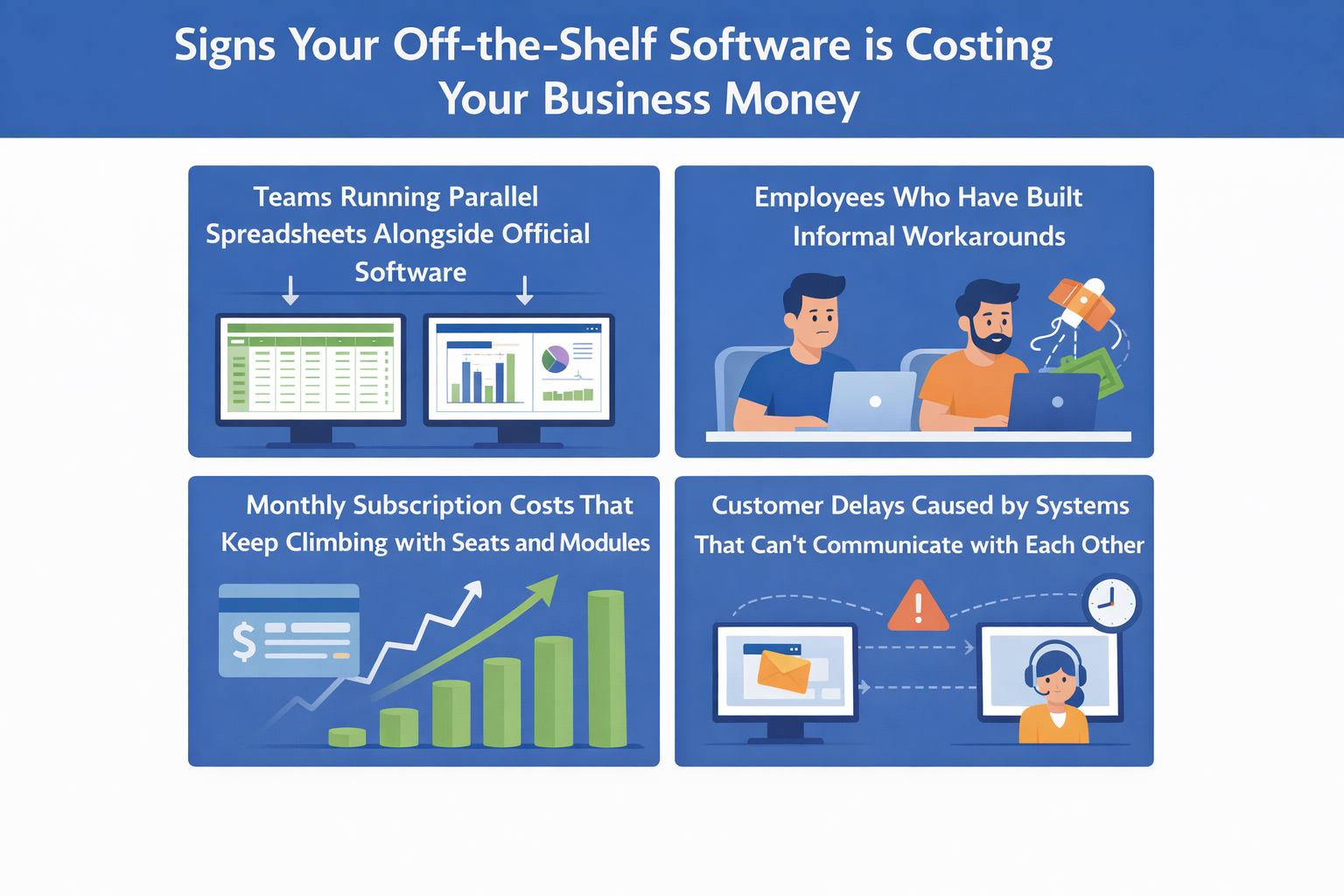
The most common warning signs are:
- teams running parallel spreadsheets alongside official software,
- employees who have built informal workarounds,
- monthly subscription costs that keep climbing with seats and modules, and
- customer delays caused by systems that can’t communicate with each other
If three or more of the signs below apply to your business, a cost comparison with custom software is worth running.
Why off-the-shelf software hides its real cost
The subscription invoice is easy to see. The hidden costs are not. When a manager spends two hours every Monday assembling a report from three system exports, their labor doesn’t show up in your software budget. It shows up as reduced capacity, slower decisions, and a talented person doing clerical work. When your sales team delays a quote because they must check inventory in a separate system and manually reconcile it, that shows up as a longer sales cycle, not a software problem.
For Kentucky businesses in manufacturing, logistics, healthcare, and professional services, these hidden costs are rarely trivial. A 100-person business with even moderate software friction typically loses $80,000–$180,000 per year in labor, errors, and missed opportunities. A purpose-built application would eliminate these costs.
8 signs your off-the-shelf software is causing you problems
SIGN 01
Your team keeps a spreadsheet “on the side”
Shadow spreadsheets are the clearest signal that your official software has stopped being trusted. When the system doesn’t have the right field, the right view, or the right workflow, people build what they need themselves. This shows up in Excel, shared Google Sheets, or a notebook on the plant floor. Each shadow spreadsheet represents unreconciled data, compliance exposure, and daily labor that should not be necessary. In a 75-person Kentucky distribution company, a single shadow spreadsheet tracking delivery exceptions typically costs 4–6 hours per week in maintenance and reconciliation. That’s $15,000–$25,000 per year in one department’s workaround for one missing feature.
SIGN 02
You’re paying for features you don’t use while missing ones you need
Off-the-shelf software is built for the average customer. If you’re not average, you end up paying for an enterprise tier to access two specific features. And the features your team actually needs are either missing, inadequately implemented, or buried in a module the vendor calls “coming soon.” The financial picture compounds over time. Consider a 60-person Kentucky business paying $900/month for a base platform plus $85/seat for 40 active users. That is $4,300/month, or $51,600/year for a tool the team uses at 55% of its capability. After five years with 10% annual increases, the total spend exceeds $315,000! All for a product that still doesn’t do what the business actually needs.
SIGN 03
Onboarding new employees takes weeks because the software is unintuitive
Software built for millions of users is optimized for the common case, not your case. When your workflows are genuinely different from the assumptions baked into the product, the gap shows up most visibly during onboarding. New hires have to learn both the software and the unofficial workarounds your team has built around it. In Kentucky manufacturing, healthcare, and professional services firms, training time on poorly fitted software typically runs 3–5 weeks before a new employee reaches full productivity. At a $28/hour burdened rate, that’s $3,360–$5,600 per hire in reduced productivity — before counting the manager hours spent on training. For a business that hires 12 people per year, the annual training cost attributable to software mismatch runs $40,000–$67,000.
SIGN 04
Your systems don’t talk to each other
Manual data re-entry between systems is one of the most expensive and least acknowledged costs in mid-market Kentucky businesses. What if an order is entered in the CRM, then manually re-entered in the ERP, then again in the shipping system, then reconciled with the accounting platform! Each transfer is an opportunity for error and a guaranteed consumption of staff time. Industry studies consistently find error rates of 1–4% in manual data entry. In a business processing 200 transactions per week, a 2% error rate means four errors per week. Each error requires identification, correction, and often customer communication. Compounded across a year, that’s 200+ errors with cascading downstream costs. A Lexington healthcare practice re-entering patient intake data across three platforms, or a Louisville distributor reconciling orders between their ERP and their carrier portal, is paying this tax daily.
SIGN 05
The vendor’s update schedule controls your business
With off-the-shelf software, you are a passenger, not a driver. When the vendor releases an update that restructures the interface, removes a feature your workflow depends on, or changes an integration that your team built a process around, you adapt or you leave. Kentucky businesses on annual contracts often discover mid-year that a feature critical to their operations is being deprecated, or that a price increase at renewal has moved them into a budget they hadn’t planned for. A small Kentucky law firm that absorbed a 40% price increase at their practice management software renewal, or a contractor whose field app removed offline mode in a forced update, has experienced the practical cost of not owning their tools.
SIGN 06
Reporting requires exporting data and massaging it in Excel
If your management team can’t get the information they need to make decisions without exporting data, building pivot tables, and manually combining multiple files — your software has failed one of its most fundamental jobs. Decision quality suffers because the reports are always slightly stale by the time they’re assembled. Decision speed suffers because the assembly process takes hours that could be minutes. And the cost is real: a Bowling Green manufacturing plant whose ops manager spends three hours every Friday afternoon building the weekly production report from three system exports is spending $11,700–$15,600 per year in that manager’s time alone, just to answer questions the software should answer automatically.
SIGN 07
Your software can’t scale with your business without a major cost jump
Seat-based pricing creates a growth tax. When your team grows from 30 to 50 people, you don’t just pay for 20 more seats, you often trigger a tier jump that reprices your entire subscription at a higher rate per seat, adds features you didn’t ask for, and locks you into a longer contract. Kentucky businesses in rapid growth phases — adding locations, taking on new contracts, expanding into new service lines — consistently find that SaaS pricing penalizes their success. A business that was paying $2,800/month for 30 seats may find itself paying $6,200/month for 55 seats after a tier change, not because the software got better, but because the vendor’s pricing model treats growth as an upsell opportunity.
SIGN 08
Customers notice the friction your software creates
This is the sign that resonates most painfully with Kentucky business owners, because it means an internal problem has become a customer experience problem. When a HVAC company’s field technicians can’t pull up job history on-site because the mobile app doesn’t sync reliably, the customer sees an unprepared technician. Or a distributor’s customer service team can’t give a real-time order status because it requires logging into two separate systems and doing mental math, the customer experiences friction in what should be a simple inquiry. When a professional services firm can’t produce an accurate invoice at month-end without a day of reconciliation, the client sees a disorganized partner. The off-the-shelf software problem has become your brand problem.
How to calculate what your current software is actually costing you
Hidden Software Cost Framework
Running this calculation before any vendor conversation gives you a grounded number to work from. This prevents you from making a decision based on sticker price alone. Organize your true software cost into three buckets:
- Direct costs
subscriptions, seats, add-on modules, support contracts $___/year
- Labor costs
hours/week on workarounds × hourly rate × 52 weeks, across all staff $___/year
- Opportunity costs
errors requiring correction, delayed decisions, customer friction $___/year
- Total #1 – #3
Your true annual software cost $___/year
Most Kentucky businesses with moderate software friction find their true annual cost is 1.5 to 3 times their subscription line item once labor and opportunity costs are included. A business paying $42,000/year in direct software costs may be paying $80,000–$125,000 in total when workaround labor and error correction are counted. At that level, a custom solution with a one-time cost of $75,000–$120,000 and $12,000/year in maintenance begins to look very different over a 5-year horizon.
Practical next step
Before any vendor conversation, ask each department head to estimate how many hours per week their team spends working around your current software rather than through it. The answers are usually more revealing than any spreadsheet. It also gives you a real number to carry into a cost comparison with a development partner.
When buying is still the right answer
Not every business with off-the-shelf software problems needs a custom build. If your workflows are genuinely standard for your industry and the market has solved your problem for basic accounting, HR, and CRM, then staying with a well-fitted off-the-shelf tool makes financial sense. The calculation tips toward custom when your workflows are genuinely distinct, when you’ve already tried two or more solutions without finding a good fit, or when the 5-year cost comparison on your true software cost (not just the subscription) closes the gap between buy and build.
Frequently asked questions
If your team spends more than 5 hours per week on software workarounds, or if your software costs have grown more than 20% in the past two years, a custom solution is worth a formal cost comparison. Most Kentucky businesses that make the switch see full ROI within 18–36 months. Especially when labor costs and opportunity costs are included in the analysis. Don’t just compare the development invoice versus the subscription fee.
Off-the-shelf software is built for a broad audience and sold to thousands of businesses. It is configured within the constraints the vendor has defined. Custom software is designed and built specifically for your business — your workflows, your data, and your team. It does exactly what you need and nothing you don’t. One trade-off is higher upfront cost versus ongoing subscription fees. Another is ownership versus dependence on a vendor’s roadmap and pricing decisions.
Custom software projects for Kentucky small to mid-sized businesses typically range from $25,000 to $150,000. This depends on complexity, number of integrations required, and includes a mobile app. Many businesses find that the 5-year total cost of ownership — development plus hosting and maintenance — is comparable to or lower than SaaS subscriptions. Including labor costs and workaround time increase the comparison gap.
Yes. Custom applications are commonly built to integrate with existing tools — including QuickBooks, Salesforce, NetSuite, industry-specific ERPs, and carrier or logistics platforms — so you don’t have to replace your entire tech stack. Many Kentucky businesses commission a custom application specifically to serve as the integration layer between two or more existing systems that don’t communicate natively. This eliminates manual data re-entry without replacing the underlying tools.
Find a True Partner
A good development partner will tell you honestly whether a custom solution makes sense for your situation or doesn’t. Be cautious of any firm that recommends building before they’ve understood your workflows and run the numbers with you.
We work with Kentucky businesses to figure out whether custom software makes financial sense — before any commitment. If you’d like a free 30-minute assessment of your current software costs, schedule a call.